
QFM015: Engineering Leadership Reading List - April 2024
 Source: Photo by Mathias Jensen on Unsplash
In the Quantum Fax Machine's April 2024 edition of Engineering Leadership Reading List we have a curated a selection of articles that weave together critical themes for engineering leaders, and that also piqued my interest over the month.
Several articles such as Improving OKRs and Abolish Performance Reviews, and 10 toxic employees to avoid focus on the employee experience, providing a some contrary examples to the usual narrative.
How to Be a Better Software Engineering Leader asks how you can be better at leading software engineering teams, whilst Everyone lies to leaders shines some light on the way that leadership fundamentally changes the relationship between people, particularly following a promotion to a senior leadership role.
Changing tack towards the practicalities of building software The Grand Unified Theory of Documentation presents a new (or at least, repackaged) way to document software, whilst For God's sake follow the Lean Startup Method implores you to rethink exactly what and how you are "doing" lean/agile product development.
Finally, in Creating Discomfort Zones we look at the (somewhat contrarian) view that favouring comfort over success is a mistaken priority of modern leadership.
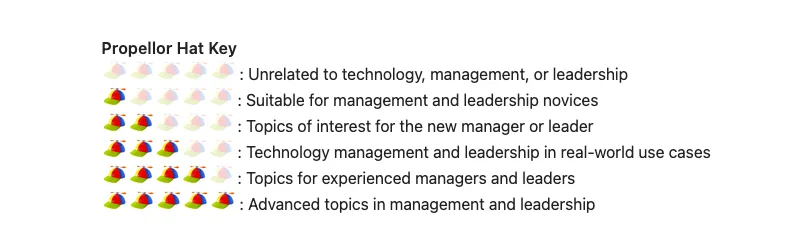
As always, the Quantum Fax Machine Propellor Hat Key will guide your browsing. Enjoy!
Links
The article dives into Sam Altman’s bold prediction about the burgeoning potential of $1B one-person businesses, emphasizing how younger generations hold a distinct advantage in this domain. It presents an optimistic view on the viability of solo entrepreneurship, resonating with those looking to leverage their individual capabilities to build significant wealth and impact without the traditional workforce or large-scale operations.
The article discusses the new market opportunities created by AI-enabled services, challenging the traditional dominance of the Big 4 and other service-heavy industries. The evolving landscape sees a shift from software-centric startups to businesses blending AI and human efforts to offer innovative solutions. Founders are encouraged to explore this promising frontier, positioning themselves as the next generation of disruptors aiming for higher margins and scalable models in various service sectors.
This article discusses a framework to assist startups in understanding their product’s position within the market. It outlines three archetypes: ‘Hair on Fire,’ ‘Hard Fact,’ and ‘Future Vision,’ each offering a unique perspective on product-market fit. Through examples and case studies, the article explains how startups can navigate their path to success by understanding customer-product dynamics, distinguishing themselves in competitive landscapes, and innovating for the future. It emphasises the fluidity of product-market fit and how companies can transition between these paths over time, using companies like Apple as an example.
This article discusses various applications of Objectives and Key Results (OKRs). It highlights how leading practitioners are refining OKRs by focusing on real outcomes rather than outputs, using a truth statement approach for setting goals, excluding numerical components from objectives, and defining key results as evidence of achieving objectives. The piece also emphasizes the importance of having fewer, more focused OKRs and suggests alignment over cascading OKRs, paired with a persistent model for aligning with long-term organisational strategy.
Phil Haack argues systematically against performance reviews, stating they are expensive, biased, and largely ineffective. Drawing from various studies and experts like Dr. William Edwards Deming, the post reveals that performance appraisals neither improve performance nor accurately reflect an employee’s contribution. Instead, they perpetuate anxiety and discouragement, fail to foster team unity, and are prone to gender biases. Emphasising this, Haack advocates for management styles that prioritise intrinsic motivation, ongoing feedback, and removing traditional performance reviews to better recognise and encourage employee value and team dynamics.
The Documentation System, as defined by David Laing, categorizes good software documentation into four essential types: tutorials, how-to guides, technical reference, and explanation, each serving a unique purpose and requiring a distinct approach. It advocates for a universal, simple documentation scheme that’s proven effective across various fields and applications, promising enhanced project success with its adoption. The system is embraced widely, applying straightforward principles to vastly improve documentation quality.
This detailed article addresses the pivotal role of first-level managers in engineering, blending technical proficiency with strategic foresight to meet company objectives. It delves into the transformative shift from traditional managerial roles to more hands-on leadership positions amidst organizational flattening. The emphasis lies on how effective management, beyond mere task delegation, can significantly influence a company’s success by fostering an environment that balances technical debt management, team development, and innovative productivity.
This article emphasises the mistaken priority of comfort over success in modern leadership. It argues that perks in the tech industry should aim to ease all but the work itself, allowing employees to focus and exert effort where it truly matters. The piece advocates for a culture of candidness and challenge, stating that avoiding tough conversations leads to stagnation and underperformance. It concludes with strategies for leaders to foster growth and face uncomfortable truths for the betterment of their teams.
Arthur O’Dwyer shares a memorable engineering interview challenge from his experience at MemSQL (now SingleStore) involving memcached, an in-memory key-value store. Tasked with adding an ‘atomic multiply by k’ operation to memcached, this challenge showcases the intricacies of working with low-level system programming and database manipulation. The story not only highlights a unique interview question but also delves into the usage of memcached, including commands like ‘incr,’ ‘decr,’ and the proposed ‘mult,’ demonstrating how these operations manage data atomically in concurrent environments.
The article discusses the impact of Generative AI and how it can exacerbate problems for companies not prepared to integrate it effectively. It contrasts this technology’s potential to speed up development processes with the challenges it poses, such as aggravating bottlenecks in systems not equipped to handle faster code generation. The distinction between companies that can leverage AI to minimise technical debt and those that cannot highlights the widening gap in industry performance. It also emphasises the importance of having a well-functioning software delivery system to truly benefit from Generative AI’s capabilities.
The article identifies ‘skilled pragmatists’ as the most significant untapped resource within companies, larger in number and potential than low performers or high achievers. Such employees, capable and practical, remain underutilised due to their aversion to office politics and visibility, focusing instead on productivity within existing systems. The piece critiques the conventional corporate approach to engagement and problem-solving, urging a reevaluation of how companies perceive and utilise this quiet majority.
Menu Home
This article introduces a practical guide on Amazon’s Press Release and FAQ (PR/FAQ) approach, emphasizing its crucial role in the ‘Working Backwards’ strategy for product development. It consolidates important starter instructions for those new to PR/FAQ writing, aiming to make the process more accessible and practical. The author shares insights and templates to help product managers (PMs) craft their first PR/FAQ, highlighting its value in strategic product thinking and execution.
This article discusses the underutilised potential of coaching within startups, especially during growth phases. The author, Aviv Ben-Yosef, emphasises the importance of properly applying coaching to empower individuals and amplify their positive impact on the organisation. He outlines a nuanced approach to coaching, moving beyond a binary view to adapt strategies based on risk and urgency, thereby fostering an environment conducive to learning and adaptation.
The article elaborates on the concept of ‘narrow waists’ in software architecture, highlighting its significance across various areas like networking, operating systems, and language design. It contrasts two styles of building software: one focused on fine-grained static types and build-time composition, and the other on coarse-grained ‘waists’ and runtime composition. The post delves into the benefits of the second style, which becomes more evident at larger scales and over longer time horizons, suggesting it encourages global economy, flexibility, generality, and extension at the cost of local convenience.
Prepare for these 11 additional interview questions to excel, from what motivates you to your greatest achievement. Each question is an opportunity to highlight your strengths and align them with the company’s mission and values.
Jacob Kaplan-Moss discusses the crucial distinction between positive feedback and praise in management, emphasizing how feedback, unlike praise, is specific to behaviors and their impacts, aimed at encouraging future performance. He advises managers on utilizing positive feedback effectively to drive improvement, and cautions about the potential pitfalls of praise, suggesting it may not always lead to the desired outcomes. The article provides practical examples of both praise and positive feedback, underlining the importance of specificity and forward-looking guidance in managerial communication.
This article explores how Agile methodologies adapt to the advancements in artificial intelligence (AI), challenging traditional practices. Agile principles, over two decades old, are based on human behavior and team productivity assumptions, which AI technology is quickly reshaping. The integration of AI into teams could significantly reduce the necessity for human team members, suggesting a future where Agile practices undergo substantial alteration to accommodate AI’s capabilities, including more significant reliance on AI for development tasks, changing team dynamics, and potentially redefining the roles within Agile frameworks.
This article delves into the paradigm shift of viewing failures within organisations not just as tolerated mistakes, but as opportunities for growth, learning, and systemic improvement. It argues that a culture that openly celebrates failures can lead to increased innovation, transparency, and resilience, fostering an environment where risk-taking is seen in a positive light and failure is used as a powerful learning tool.
This video presents a novel approach to unify development teams by focusing on the comprehensive narrative of the system rather than fragmented tasks and documentation. This methodology aims to streamline teamwork and enhance understanding of the system in its entirety.
This article tackles not only the evident reasons behind the failure of software projects but delves into the subtler, often overlooked aspects. It stresses how overconfidence among developers, inexperienced management, and mismanaged stakeholders contribute significantly to project derailments. The insights provided by both the author and commenter reflections paint a comprehensive picture of the multifaceted nature of project failures, emphasizing the need for realistic estimations, the importance of acknowledging and learning from failures, and the vital role of clear communication and objective setting in the success of software projects.
Toxic employees can devastate your workplace culture and productivity, as shown by Harvard research. Learn about the ten types of harmful personalities and how to identify and manage them effectively.
Jason Cohen explores the paradoxical idea that not making mistakes—or blundering—is a significant part of achieving success, especially in chess and start-ups. The article delves into the concept that avoiding common pitfalls can often lead to victory, emphasizing the importance of knowing what not to do. Cohen uses chess as a metaphor to illustrate how avoiding blunders is crucial for success, and applies this lesson to startups, advising founders to focus on avoiding major mistakes to increase their chances of thriving.
This article critiques the “Lean Startup” method, emphasizing that while the concept is widely embraced, it may not be fully understood or correctly implemented by many entrepreneurs. It argues that the iterative approach and customer feedback strategies often lead to incremental rather than revolutionary improvements.
This article explores modern approaches to organisational design, focusing on adaptive and evolutionary models over traditional hierarchical structures. It discusses the concept of antifragile organisations that thrive on change and delves into three specific frameworks: Holacracy, Agile Squads, and Self Organising. By examining companies like Valve, Spotify, and Medium, the piece illustrates how these models distribute authority and foster an environment of continuous evolution, aiming for organisations that are more responsive to technological advancements and employee autonomy.
Regards,
M@
[ED: If you’d like to sign up for this content as an email, click here to join the mailing list.]
Originally published on quantumfaxmachine.com.
Also cross-published on Medium and Slideshare:
Was this useful?