QFM075: Engineering Leadership Reading List - July 2025
 Source: Photo by Dylan Gillis on Unsplash
This month's Engineering Leadership Reading List examines workplace dynamics and strategy. Why Engineers Hate Their Managers (And What to Do About It) addresses common friction points. How to Care About Your Job When It Doesn't Care About You offers perspective on maintaining motivation.
Comparison of Three Strategy Alignment Frameworks helps leaders choose approaches, while My LLM Codegen Workflow ATM shares practical AI development workflows.
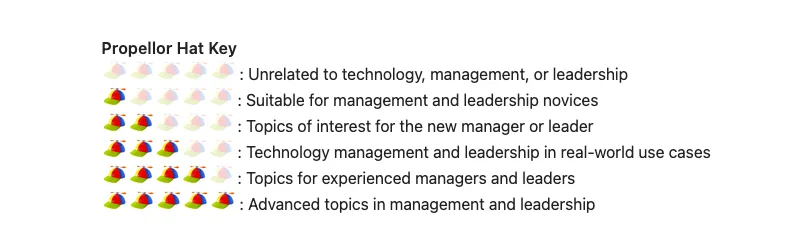
As always, the Quantum Fax Machine Propellor Hat Key will guide your browsing. Enjoy!
Links
Kevin Kelly exemplifies an alternative model of impact through what he calls "Hollywood style" work—a portfolio of creative projects spanning publishing, technology advising, art, and activism—rather than pursuing a single unicorn venture. His contributions across the Whole Earth Catalog, WIRED magazine, the creator economy concept of "1,000 true fans," and the 10,000-year Clock project demonstrate that sustained influence and meaningful work don't require building a dominant company, challenging Silicon Valley's narrow definition of ambition and success.
Ineffective managers frustrate engineers through common anti-patterns: interrupting deep focus with excessive meetings, making technical decisions without coding expertise, and taking credit for their team's work. The best managers understand that programming requires uninterrupted concentration, respect the technical complexity engineers navigate daily, and properly attribute accomplishments to the people who built them.
Organizations fundamentally exist to serve their own purposes—profit, growth, or public service—making employees inherently subordinate means to those ends, regardless of stated values like "family" culture. Since companies are emergent collectives of competing interests rather than rational actors, their decisions will inevitably appear irrational, inconsistent, and dismissive of individual contributors, making it impossible for the organization to genuinely care about its workers. Recognizing this structural reality allows employees to meaningfully contribute and find satisfaction in their work without the psychological damage of expecting organizational loyalty in return.
Harper Reed outlines a three-phase LLM-assisted software development workflow: (1) idea honing through conversational prompting to generate a detailed specification, (2) planning using reasoning models to break the project into properly-sized, test-driven implementation steps, and (3) execution using LLM codegen to implement each step incrementally. The approach emphasizes discrete loops, comprehensive planning before implementation, and iterative refinement to avoid common pitfalls like wasted time and orphaned code.
The article compares three strategy alignment frameworks—OKRs, Spotify Rhythm, and Art of Action Strategy Briefing—by evaluating their core capabilities for achieving strategic alignment in agile and tech organizations. OKRs, originating from Intel and popularized by Google, are contrasted with Spotify's iterative approach (which borrowed from both OKRs and Art of Action) and Bungay's Art of Action framework (rooted in military maneuver warfare and used by Mercedes F1). The analysis emphasizes that alignment frameworks must include both artifacts and processes to support critical capabilities like line of sight, achievability feedback, and situational awareness, with the author drawing insights from implementations across multiple tech companies to help organizations choose the best fit for their specific context.
Regards,
M@
[ED: If you'd like to sign up for this content as an email, click here to join the mailing list.]
Originally published on quantumfaxmachine.com and cross-posted on Medium.
hello@matthewsinclair.com | matthewsinclair.com | bsky.app/@matthewsinclair.com | masto.ai/@matthewsinclair | medium.com/@matthewsinclair | xitter/@matthewsinclair
Was this useful?