QFM083: Engineering Leadership Reading List - September 2025
 Source: Photo by Headway on Unsplash
This month's Engineering Leadership Reading List examines AI impact on leadership and product management. AI: What CEOs Get Wrong About Prototypes challenges common misconceptions about AI demonstrations. Advanced Context Engineering for Coding Agents provides a framework for building effective AI developer tools.
The Last Days of the Managerial Class explores how AI might transform traditional management roles, while A PM's Guide to AI Agent Architecture helps product managers understand autonomous systems.
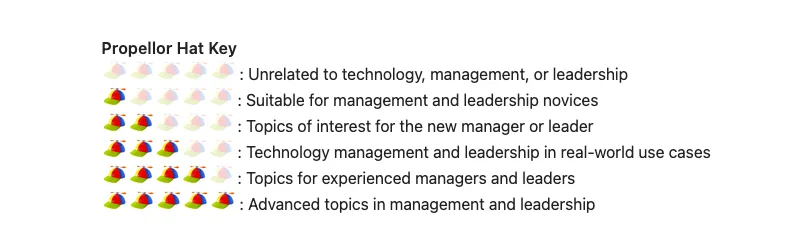
As always, the Quantum Fax Machine Propellor Hat Key will guide your browsing. Enjoy!
Links
Good UI design fundamentally relies on two principles: alignment and consistency, which address why subtle misalignments (like inconsistent icon positioning or varying element weights) make interfaces feel jarring even when invisible to untrained eyes. The author achieved dramatic visual improvements in Lighthouse by focusing exclusively on these two aspects rather than pursuing expert-level design knowledge, and recommends maintaining consistency across pages over local optimization and leveraging existing component libraries to enforce design coherence efficiently.
Most product roadmaps are actually just prioritized feature lists lacking underlying product strategy, leading teams to rely on scorecards like RICE rather than strategic thinking. To transform a feature backlog into an outcome-oriented roadmap, you must first consolidate all ideas and opportunities, then extract the true strategic narratives—the "why" behind each initiative—by questioning whether features address primary goals or secondary effects. This distinction between primary intent (eg new customer acquisition) versus tangential benefits (eg reducing churn) fundamentally shapes discovery activities and solution design, making narrative clarity essential for effective roadmap communication and execution.
Artificial intelligence is dismantling the traditional management career pathway by automating the core tasks—research, analysis, communication, and coordination—that justified managerial roles and their prestige within corporate hierarchies. This disruption exposes a long-standing feature of American professional culture where status increased inversely with tangible output, revealing that much of what managers did was less essential than previously believed. The emerging economy now rewards domain expertise and measurable production over the "high optionality" and generalist credentials that once defined the fast track to executive positions.
AI agent success depends less on raw capability (accuracy, speed) and more on architectural decisions that build user trust, particularly through intelligent context management and graceful escalation rather than attempting to solve every problem autonomously. PMs must design agents across four layers—context & memory, data integration, reasoning capability, and escalation patterns—where the counterintuitive approach of admitting limitations and routing complex issues to humans actually drives higher adoption than maximizing agent autonomy.
AI can rapidly generate prototypes in days, but production-ready systems require exponentially more work including error handling, security, compliance, integrations, and scalability that demand significant human expertise. CEOs often misjudge timelines by only seeing the visible prototype layer (the iceberg tip) while underestimating the underlying infrastructure complexity that grows as products progress through MVP, product-market fit, and traction stages. CTOs must communicate that while AI excels at prototype generation, each maturation stage multiplies code size and complexity, making development increasingly difficult and slower as new features must integrate with existing systems and regulatory requirements.
Regards,
M@
[ED: If you'd like to sign up for this content as an email, click here to join the mailing list.]
Originally published on quantumfaxmachine.com and cross-posted on Medium.
hello@matthewsinclair.com | matthewsinclair.com | bsky.app/@matthewsinclair.com | masto.ai/@matthewsinclair | medium.com/@matthewsinclair | xitter/@matthewsinclair
Was this useful?