
QFM087: Engineering Leadership Reading List - October 2025
 Source: Photo by Vitaly Gariev on Unsplash
This month's Engineering Leadership Reading List examines AI's impact on teams and modern leadership practices. Team dynamics after AI explores how AI tools are reshaping collaboration patterns, while Just Talk To It - the no-bs Way of Agentic Engineering offers practical guidance on integrating AI assistants into development workflows. The Tiny Teams Playbook - by Shawn swyx Wang presents strategies for high-performing small teams.
Leadership development features prominently with Engineering Leader's Guide: How to Become a Great Coach and Mentor and Advice for New Principal Tech ICs providing career guidance for senior technical roles. The Hidden Architecture of Engineering reveals the organisational structures that enable effective engineering teams.
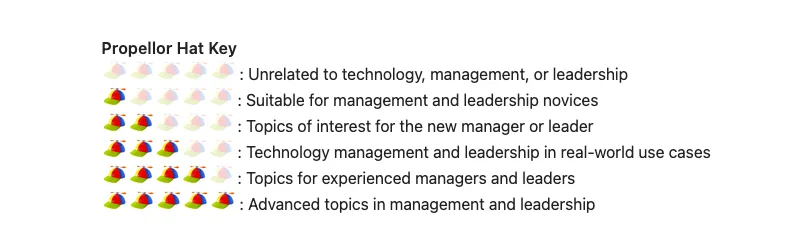
As always, the Quantum Fax Machine Propellor Hat Key will guide your browsing. Enjoy!
Links
Engineering leaders must transition from individual technical excellence to developing others through coaching and mentoring, as their success is now measured by team accomplishments rather than personal contributions. This shift requires replacing the "I'll do it myself" mindset with one focused on building trust, delegating, and creating environments where team members can excel. The most effective engineering leaders prioritize elevating those around them over solving problems individually, fundamentally changing how they measure their own value and impact.
Organizational structure is a critical system design tool that shapes information flow, decision-making, and deployment speed, yet most engineering leaders inherit rather than intentionally design their organizations. The author demonstrates through examples from Adobe (function-based teams that slowed feature delivery) and Spotify (autonomous cross-functional squads that deployed independently) that organizations ship their org chart—product architecture mirrors communication structures per Conway's Law. Rather than copying templates like "two-pizza teams" or the Spotify model, effective organizational design requires solving your specific problem by aligning team structure, incentives, and ownership boundaries with your company's actual strategy and context.
Principal engineers must develop a flexible leadership style suited to their strengths—whether through deep technical expertise, horizontal influence, or organizational alignment—while shifting focus from individual coding contributions to multiplying team effectiveness through vision-setting, design feedback, and cross-organizational collaboration. The role demands constant communication and persuasion to build momentum around technical initiatives that the organization doesn't yet value, treating failure as acceptable when attempting to shape long-term technical direction across multiple teams and leadership levels.
AI adoption discourse wrongly assumes inevitability and feasibility as the primary concerns, when the actual critical question is desirability—whether magnifying quantifiable, legible outputs through AI systems is worth the cost to the illegible social and political dimensions of work that increasingly dominate as organizations scale. As AI systems bias toward what can be measured, team leaders must recognize that the hidden work of human relationships and organizational dynamics, not individual capability amplification, determines outcomes in large-scale operations.
Gallup's research analyzing nearly 1 million employee-manager interviews identified 16 key statements (the Q12+ survey) that predict employee engagement, covering expectations, resources, recognition, development, purpose, respect, and feedback—forming a comprehensive framework that reveals what great managers must actively provide to their teams. The article presents this as one of three rigorously researched expert lists offering specific, actionable manager activities, contrasting with generic leadership advice that lacks workplace specificity. These evidence-based engagement drivers serve as a finite checklist for managers to assess and improve their effectiveness.
The Tiny Teams Playbook synthesizes operational insights from 7 high-efficiency startups (100+ people, $200M+ ARR) that leverage AI agents to maximize productivity with minimal headcount, identifying key patterns across hiring (work trials, top-market salaries, senior generalists), operations (minimal meetings, AI-augmented staffing, compound learning), and technology (simple tech stacks, feature flags, internal benchmarking). The framework positions Tiny Teams as the next organizational transition in the AI era, where inter-human trust and I/O become the primary bottleneck rather than capital or engineering effort, enabling smaller teams to operate with greater speed and adaptability than traditional org structures.
SaaS vendors have shifted from their original promise of flexibility and cost savings to prioritizing customer lock-in and compliance over genuine organizational success, using customer satisfaction metrics and dedicated success managers primarily as retention tools rather than enablers of actual value. The industry's reliance on standardized "best practices" and network effects creates dangerous vulnerabilities by obscuring the loss of organizational context and know-how, while accumulating technical complexity that data recovery systems cannot address, leaving companies dependent on unpredictable information systems despite believing they're following industry standards.
The author has shifted to using OpenAI's codex CLI as their primary tool for agentic engineering, running 3-8 parallel agents simultaneously in a terminal grid to generate ~100% of code for a large TypeScript React application with multiple platform targets. Rather than over-engineering prompts or agent configurations, the key strategy involves managing "blast radius"—carefully scoping changes to minimize file impacts, enabling atomic git commits and easy rollback—while maintaining the ability to stop agents mid-execution and course-correct without losing work. The author prefers gpt-5-codex on mid settings over Claude Code due to its more pragmatic execution style and superior file context awareness, emphasizing that practical iteration and rapid feedback loops outperform elaborate prompt engineering or infrastructure like worktrees and PRs.
Regards,
M@
[ED: If you'd like to sign up for this content as an email, click here to join the mailing list.]
Originally published on quantumfaxmachine.com and cross-posted on Medium.
hello@matthewsinclair.com | matthewsinclair.com | bsky.app/@matthewsinclair.com | masto.ai/@matthewsinclair | medium.com/@matthewsinclair | xitter/@matthewsinclair
Was this useful?